


Running a self-managed HOA means you’re doing the work of a property manager, except you’re doing it for free, in your spare time, while also living in the community you’re managing. If that sounds exhausting, it’s because it can be.
But here’s what most guides won’t tell you: self-management doesn’t fail because board members don’t care. It fails because there’s no clear system for organizing the work. You end up with email chains no one can follow, financial records scattered across three laptops, and questions that require someone to remember what happened two years ago.
This guide walks through the 6 operational areas that make or break a self-managed HOA. It’s not about doing more. It’s about doing things in a way that keeps the board functional and keeps you from burning out. For a deeper dive into what self-management entails and whether it’s right for your community, check out our complete guide to self-managed HOAs.
Step 1: Get Clear on Who’s Responsible for What
The first source of stress in most self-managed HOAs isn’t the work itself. It’s not knowing who’s supposed to be doing it. One person thinks someone else is handling vendor follow-up. Another assumes the treasurer is tracking violations. Meanwhile, the homeowner who emailed three weeks ago is still waiting for an answer.
You don’t need titles, you need ownership
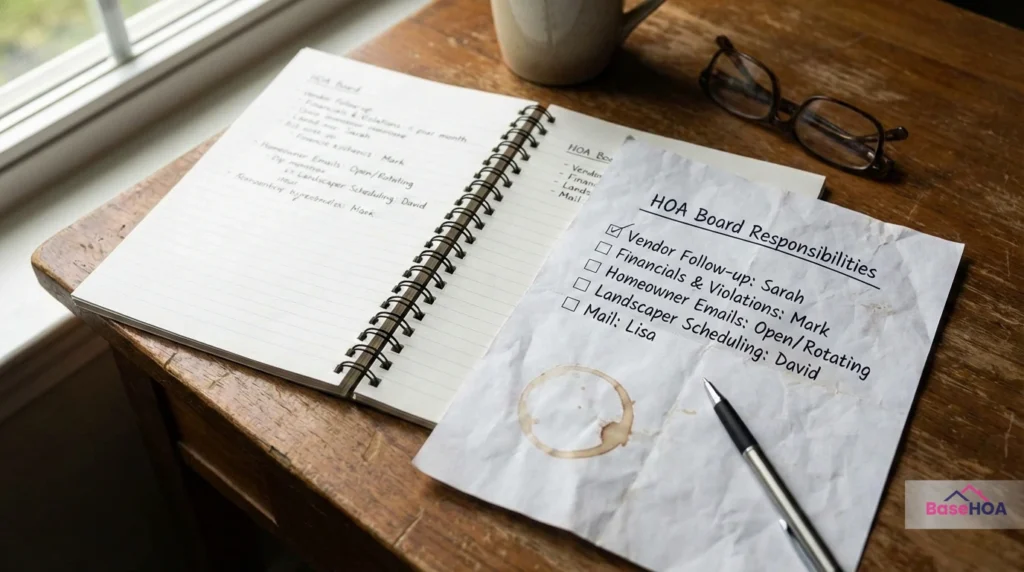
You don’t need fancy titles or a formal org chart. You just need everyone on the board to know what they own. That means being specific: who opens the mail, who updates the financials, who sends violation notices, who schedules the landscaper, who responds to homeowner questions.
If the answer to any of those is “whoever gets to it first,” you’re going to have gaps. Write it down. Share it with the full board. Update it when responsibilities shift. This isn’t bureaucracy. It’s just making sure work actually happens.
Understanding what each role on an HOA board of directors typically handles can help you divide responsibilities more effectively and avoid confusion about who owns what.
Step 2: Put Basic HOA Financial Systems in Place Early
Money is where most self-managed boards feel the most pressure. It’s not because the finances are complicated. It’s because when something’s unclear, people assume the worst. A late dues payment becomes “is someone stealing?” A missing receipt becomes “did we overpay?”
What financial organization actually looks like for small HOAs
Financial organization for a small HOA doesn’t require accounting software or a CPA. It requires visibility and consistency. That means homeowners can see what they owe, the board can see what’s been paid, and everyone knows where the money went.
At minimum, you need a way to track who’s paid and who hasn’t, a shared place to store receipts and invoices, and regular statements that show income and expenses. If you’re still using a personal checking account or a shared spreadsheet that only one person can access, you’re making this harder than it needs to be.
The goal isn’t perfection. It’s making sure no one has to dig through old emails to answer a basic financial question. Creating clear HOA statements helps both the board and homeowners understand exactly where money is coming from and where it’s going.

Step 3: Make Meetings Predictable (Not Perfect)
The actual decisions happen over text, in hallway conversations, and in one-on-one calls between board members. The meeting is where you make those decisions official and document them for the next board.
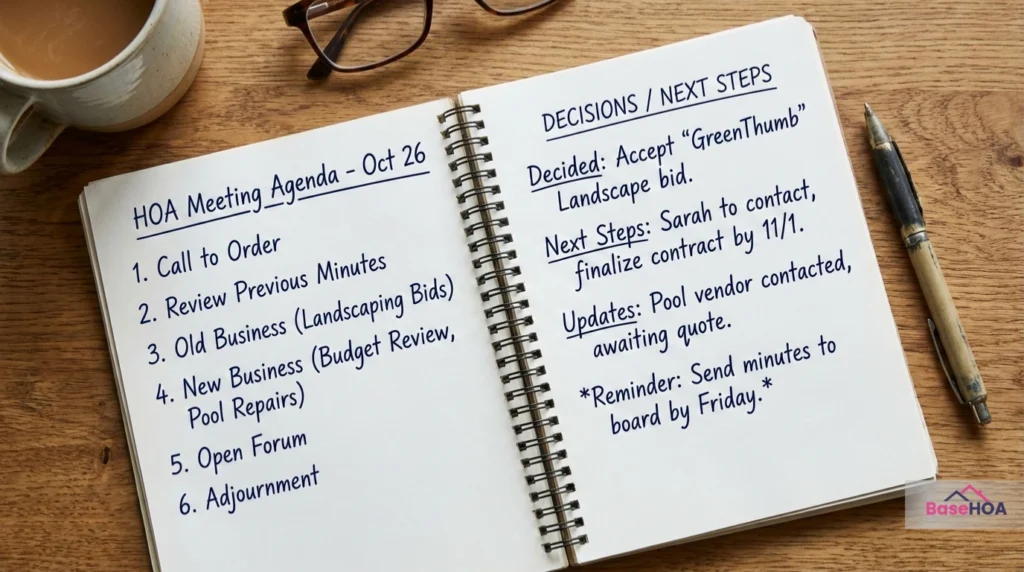
That’s why consistency matters more than polish. Pick a schedule and stick to it. Use a simple agenda so people know what’s being discussed. Take notes that capture decisions, not full transcripts. Make sure someone other than the person who ran the meeting can understand what happened.
What you should always walk away with
Here’s what every meeting should produce:
- A record of what was decided
- Clear next steps and who owns them
- Updates on outstanding items from last time
If you’re walking out of meetings without those three things, the meeting didn’t do its job.
Knowing how to run effective HOA meetings and properly document decisions through meeting minutes creates the institutional memory your HOA needs to function year after year.
Step 4: Handle Rules and Violations the Same Way Every Time
Enforcement is where fairness and memory collide. Someone parks in a guest spot overnight, and you’re not sure if you warned them already. Another homeowner submits a complaint about a fence, and you can’t remember if you approved it six months ago.
This isn’t about being strict. It’s about being consistent. If you enforce rules based on who remembers what, you’re going to end up with selective enforcement, frustrated homeowners, and board members who feel like they’re making it up as they go.
The fix is simple: document everything. If you send a warning, write it down. If someone disputes a violation, record their response. If you decide not to enforce something, document why. That way, the next time a similar issue comes up, you’re not starting from scratch. You’re following precedent.
Consistency doesn’t mean zero flexibility. It means treating similar situations the same way and being able to explain your reasoning if someone asks. Understanding the most common HOA violations and how to handle them fairly helps boards enforce rules while protecting themselves from claims of bias.
Step 5: Keep All HOA Records in One Place (Future You Will Thank You)
Here’s the scenario every self-managed board dreads: someone asks for a copy of last year’s budget, and the person who handled it just moved out of state. Or a new board member takes over, and no one can find the vendor contracts. Or a homeowner requests meeting minutes from three years ago, and you’re legally required to provide them, but they’re in someone’s personal email.
The real risk isn’t today. It’s next year’s board trying to operate without the context you have right now. If your records live in individual inboxes, personal hard drives, or a filing cabinet in someone’s garage, you’re one board turnover away from institutional amnesia.
What “organized” actually means in real life
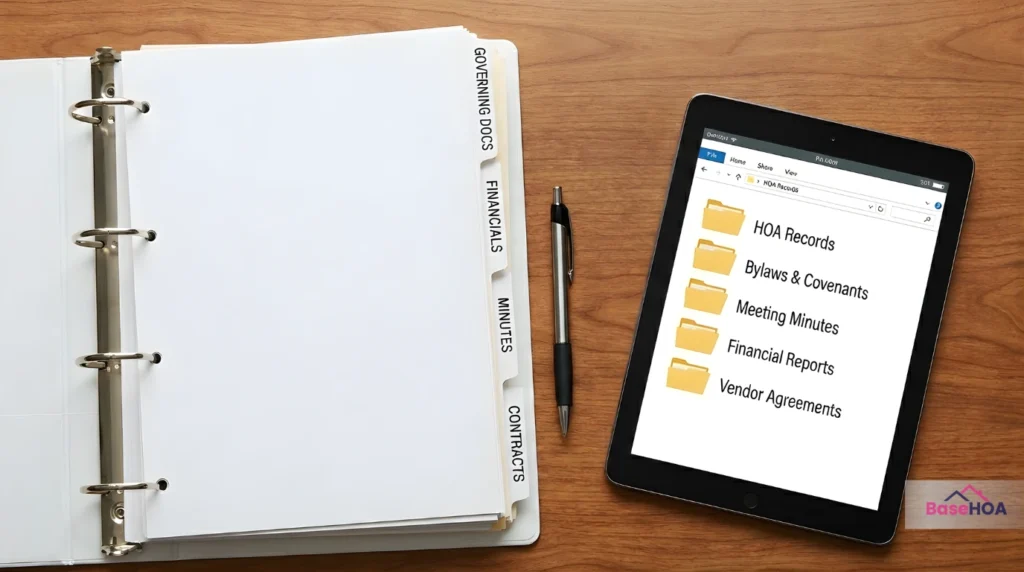
Organized doesn’t mean perfect. It means having one shared place where governing documents, financial records, meeting minutes, vendor contracts, and correspondence live. It means new board members can get up to speed without pestering the person who came before them. It means you can answer a homeowner’s question without sending a group text asking “does anyone remember?”
Most states have specific record retention requirements that dictate what HOAs need to keep and for how long. According to the Texas State Law Library, Texas requires permanent retention of certificates of formation, bylaws, and restrictive covenants, while financial records and meeting minutes must be kept for seven years. If you’re not sure what applies in your state, check with an attorney before you toss anything.
You’re not doing this for yourself. You’re doing it for the board member who takes over when you’re done.
Step 6: Communicate in a Way That Reduces Questions, Not Creates Them
Most communication problems in self-managed HOAs aren’t about frequency. They’re about clarity. You send an email about a special assessment, and homeowners reply with questions you already answered. You post an update in the Facebook group, but half the community doesn’t use Facebook. Someone asks for a copy of the bylaws, and you’re not sure where the current version lives.
The solution isn’t more messages. It’s giving homeowners one place to look first. That means clear, proactive updates about the things people actually care about: what’s happening with the budget, when the next meeting is, what decisions were made, what work is being done.
If homeowners are asking the same questions over and over, it’s not because they’re not paying attention. It’s because the information isn’t easy to find. Create a single source of truth for documents, updates, and FAQs. Make it accessible without requiring someone to email the board. Keep it current.
When communication works, it’s invisible. When it doesn’t, it’s the only thing people talk about.
Why Self-Managed HOAs Burn Out (Even When Everyone Cares)
Burnout in self-managed HOAs doesn’t happen because board members stop caring. It happens because the workload keeps growing while the systems stay the same.
You start with good intentions and a manageable amount of work. Then someone moves out, and their responsibilities get redistributed. Another board member gets busy with their job, and you pick up the slack. Homeowners start texting you directly because it’s faster than email. Financial questions come in at random times because there’s no organized way for people to check their balance or payment history.
Before long, being on the board feels like having a second job, except you’re not getting paid and there’s no clear end in sight. Research published in the nonprofit sector has shown that volunteer burnout manifests through emotional exhaustion, reduced sense of accomplishment, and disengagement from responsibilities. In HOA settings, this might look like a treasurer ignoring emails, a president abruptly resigning, or a board that can’t get enough members to attend meetings.
The mistake most boards make is thinking the solution is working harder. But the problem isn’t effort. It’s structure. If every task requires someone to remember context, if every question requires manual follow-up, if every new board member has to learn the system from scratch, you’re fighting the same battles over and over.
Self-management works when the board has a system that organizes the work instead of adding to it. That doesn’t mean hiring a property manager. It means having tools that make it easier to track finances, store records, communicate with homeowners, and document decisions so the next board doesn’t start from zero.
How the Right System Makes Self-Management Sustainable
Software doesn’t replace volunteers. It supports them. The right system doesn’t ask you to do more. It organizes what you’re already doing so you can actually keep up with it.
That means giving homeowners a portal where they can check their balance, make payments, and access documents without emailing the board. It means storing meeting minutes, financial records, and vendor contracts in one shared place so you’re not hunting through old emails. It means tracking violations and communications so everyone knows what’s been said and what’s been done.
It means the work gets easier to hand off, because the system holds the context instead of forcing the next board to reverse-engineer everything.
Self-management doesn’t have to mean doing everything manually. It just means keeping control of your HOA’s operations and having a system that helps you do it without burning out.
Give your board one place to organize everything.
Start a free BaseHOA trial. No credit card required.