



If you’re running your HOA without a property manager, you already know how overwhelming it can get. Between collecting dues, organizing meetings, enforcing rules, and keeping records straight, it’s easy to feel like you’re juggling too many responsibilities at once. You didn’t sign up to become a professional manager. You’re a volunteer trying to keep your community running smoothly, but without clear systems in place, the work piles up fast.
This guide will walk you through everything your board needs to know: what responsibilities actually fall on your shoulders, how to set up workflows that won’t leave you scrambling, and which tools can help you stay organized without adding more to your plate. By centralizing your processes, you can spend less time chasing paperwork and more time making decisions that actually matter.
What Is a Self-Managed HOA?
A self-managed HOA is a homeowners association run entirely by volunteer board members without hiring a professional property management company. The board handles all operations directly, from collecting dues and organizing meetings to enforcing community rules and maintaining financial records.
Unlike professionally managed associations where a property manager handles day-to-day tasks, your board members take on these responsibilities themselves. This means you’re in complete control of decisions, timelines, and how things get done in your community.
Many boards choose this approach to save on management fees, maintain direct oversight of finances, or simply because they prefer handling things their own way. Smaller communities with straightforward needs often find it works well, especially when board members are willing to put in the time and stay organized.
How Self-Managed Boards Operate Differently
The biggest difference is control. You’re not waiting on a third party to respond to homeowner questions or process a payment. When something needs attention, your board makes the call and takes action immediately.
This also means more transparency. Homeowners can see exactly how decisions are made and where their dues go. There’s no middleman filtering information or presenting summaries, everything’s handled directly by people who actually live in the community.
But with that control comes responsibility. Every task that a property manager would normally handle now falls on your board. Financial tracking, meeting preparation, violation follow-ups, document storage, it all lands on volunteers who already have full-time jobs and personal commitments.
Core Responsibilities of a Self-Managed HOA Board
When you’re managing your own association, every operational task becomes your board’s job. It’s not just about making big decisions at quarterly meetings, it’s the daily and weekly work that keeps things running. And when these responsibilities get neglected, even temporarily, the consequences show up fast.
Late payments pile up because no one’s tracking them. Meeting minutes never get filed, so you can’t remember what was actually decided six months ago. Violations go unenforced, and suddenly you’re dealing with complaints about selective enforcement. Let’s break down what you’re actually responsible for.
Managing Finances
You’re collecting dues, paying vendors, tracking income and expenses, and making sure your community stays solvent. This means monitoring who’s paid on time, following up with homeowners who haven’t, reconciling bank statements, and keeping your budget on track throughout the year.
You might be chasing late payments while balancing the budget, and it’s exhausting without a system. Miss a few follow-ups, and suddenly you’re short on funds when a repair bill arrives. Lose track of expenses, and you won’t know if you’re overspending until it’s too late to course-correct.
Your board also needs to prepare annual budgets, file taxes if required, and maintain financial statements that homeowners can review. Every dollar coming in and going out should be documented clearly, not scattered across personal bank accounts or forgotten in email threads.
Meetings & Records
Every meeting needs an agenda prepared in advance, minutes recorded accurately, and decisions documented in a way that future boards can actually reference. This isn’t just about compliance—it’s about protecting your board from disputes and making sure everyone’s on the same page.
Disorganized records mean extra work and confusion later. When you can’t find the vote from last year’s meeting about pool repairs, you end up relitigating the same issues over and over. Homeowners ask questions you’ve already answered, but you can’t point them to documentation because it doesn’t exist in an accessible format.
Your board needs a consistent process for meeting preparation, note-taking during sessions, and storing everything afterward. If it’s not written down and filed properly, it might as well have never happened.
Rules, Violations & Communication
Enforcing your community’s rules fairly means documenting violations, sending notices, following up consistently, and making sure similar situations get similar treatment. You want fairness, but it can feel like walking a tightrope between enforcement and keeping neighbors happy.
The problem isn’t usually the rules themselves, it’s applying them consistently when you’re dealing with real people you see every day. One board member might be stricter about lawn maintenance, another more lenient about parking. Without a standard process, homeowners notice the inconsistency, and suddenly you’re fielding complaints about favoritism.
Beyond enforcement, you’re also the primary communication channel for your community. Homeowners need answers about dues, maintenance schedules, rule changes, and upcoming work. If they can’t get clear information from your board, frustration builds fast.
Document Storage & Transparency
Your governing documents, financial statements, meeting minutes, vendor contracts, insurance policies, all of it needs to be stored somewhere accessible. Not just accessible to board members, but available to homeowners who have a legal right to review association records.
When documents live in one board member’s personal email or on someone’s laptop, they’re effectively invisible to everyone else. New board members can’t onboard properly. Homeowners can’t verify information. And when that person leaves the board, critical records might disappear entirely.
You need a central location where everything’s organized, backed up, and available to the right people. Not just for convenience, but to maintain the transparency that makes communities trust their leadership.
How to Run a Self-Managed HOA (High-Level Workflow)
Here’s how you can bring it all together without losing your mind. The key isn’t working harder, it’s setting up systems that handle the routine work so you can focus on actual decisions.
Centralizing Records
Stop storing meeting minutes in one person’s email, financial records in another’s spreadsheet, and governing documents on someone’s desktop. Everything related to your association should live in one central location that doesn’t disappear when someone leaves the board.
This means all your bylaws, CC&Rs, budgets, meeting notes, violation records, and correspondence get filed in the same system. When a homeowner asks for last year’s financial statement or a new board member needs to understand past decisions, you know exactly where to look.
Centralization also protects your community. If records are scattered and informal, you risk losing critical information during board transitions. Worse, you might not be able to produce required documents during disputes or audits.
Standardizing Communication
Create clear channels for how homeowners reach your board and how your board responds. Maybe it’s a dedicated email address, a community portal, or regular office hours, but it shouldn’t be random text messages and personal phone calls at all hours.
Standard communication also means consistent messaging. When three different board members give three different answers about the same pool closure, homeowners don’t know who to believe. Document your decisions, share them through official channels, and make sure everyone’s working from the same information.
This protects your time too. Without boundaries, you’ll be answering individual questions 24/7 instead of addressing issues once for the entire community.
Tracking Violations & Dues
Don’t rely on memory or informal notes when it comes to money and enforcement. Every violation needs a dated record of what happened, what notice was sent, and how it was resolved. Every payment should be logged immediately with a clear paper trail.
This isn’t about being rigid, it’s about being fair and protecting your board. When you can show that you’ve applied rules consistently and followed proper procedures, you’re covered if someone challenges your decisions. When your financial records are airtight, you can prove exactly where funds went.
Manual tracking on spreadsheets works until it doesn’t. You forget to follow up on a violation. You miss a late payment. You lose track of which homeowner already received a warning. Small gaps become big problems when they accumulate.
Most self-managed boards struggle because they don’t have one central system, you can fix that and actually enjoy running your community.
Self-Managed HOA Challenges (And Why Boards Burn Out)
We know how much work this is. You’re juggling finances, meetings, rules, and documents all at once, usually in whatever spare time you can find between your actual job and personal life. Most board members start with good intentions and plenty of energy, but within a few months, reality hits hard. According to the Foundation for Community Association Research, volunteer board members collectively perform nearly 98.5 million hours of service annually, managing responsibilities that would otherwise require professional staff.
The biggest challenge isn’t any single task — it’s that everything’s interconnected. You can’t just “do the finances” without tracking who’s paid, sending reminders, documenting late fees, and reconciling accounts. You can’t enforce violations without creating records, sending notices, tracking responses, and following up consistently. Every responsibility spawns a dozen smaller tasks that someone needs to remember and complete.
Then there’s the volunteer fatigue. Board members burn out because they’re doing work that would be someone’s full-time job, except they’re doing it for free while also working, raising families, and trying to have some semblance of a personal life. When processes aren’t streamlined and records aren’t organized, even simple tasks take three times longer than they should. Eventually, good people step down because it’s just not sustainable, and suddenly your board can’t maintain quorum.
Tools Self-Managed HOAs Need to Operate Smoothly
You don’t need to do this all manually — you can have one place to track meetings, documents, payments, and communications. The right system doesn’t add complexity; it removes it by giving you a single location where all your association work happens.
Think about what would change if you could log into one platform and immediately see which dues are outstanding, what violations need follow-up, when your next meeting is scheduled, and where all your documents are stored. No more digging through email threads. No more spreadsheets that three different board members are updating separately. No more wondering if you remembered to send that notice two weeks ago.
Modern HOA software handles the repetitive work that drains your time. Payment tracking happens automatically. Meeting reminders go out on schedule. Violation workflows keep you consistent. Document storage stays organized without manual filing. You’re not replacing your judgment or decision-making, you’re just eliminating the administrative chaos that makes everything harder than it needs to be.
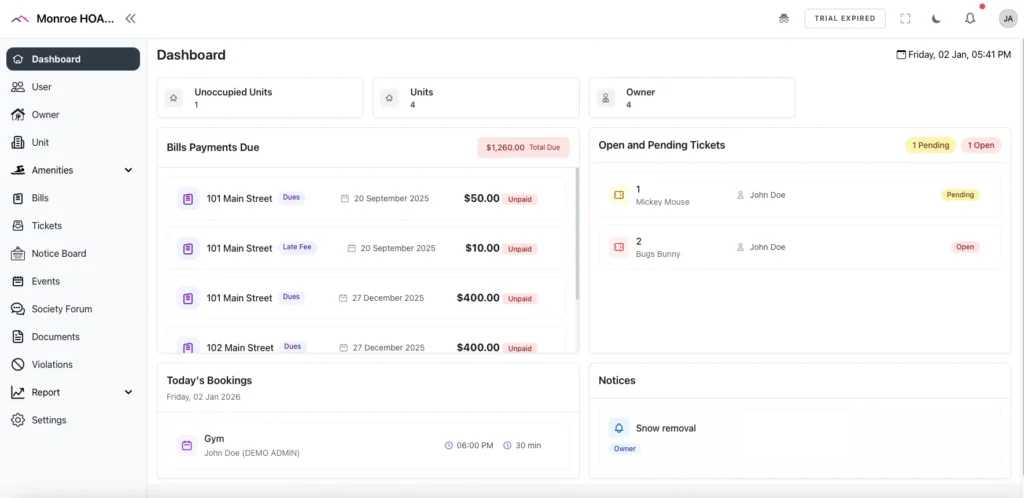
BaseHOA was built specifically for boards like yours, volunteers who need professional-level organization without professional-level complexity. Start a free BaseHOA trial to organize your HOA operations in one place.
Self-Managed HOA vs Hiring a Property Manager
The comparison isn’t really about which option is objectively better — it’s about what works for your specific community and what your board can realistically handle.
Cost is usually the first consideration. Management companies typically charge a percentage of your collected dues or a flat monthly fee, which can add up significantly over time. That money could go toward community improvements instead. On the other hand, your board’s time has value too, and if volunteers are burning out or making costly mistakes due to disorganization, you might not actually be saving money.
Control is the second factor. When you manage internally, your board makes every decision without waiting for third-party approval or input. You set timelines, priorities, and processes based on what your community actually needs. Professional managers bring experience and systems, but they’re also juggling multiple communities and might not be as responsive or invested in your specific issues.
Transparency tends to be higher with internal management. Homeowners can attend meetings, review records directly, and see exactly how their dues are being spent without information being filtered through a management company. But that transparency only works if your board maintains organized, accessible records, which brings us back to needing good systems in place.
The biggest question is whether your board has the capacity, not just the willingness. Do you have enough active volunteers to split responsibilities? Can someone handle financial tracking competently? Is there bandwidth for consistent communication and follow-up? Compare your options in detail here.
Is a Self-Managed HOA Right for Your Community?
This isn’t for everyone. Here’s when self-management works and when it can be too much.
It works well when your community is relatively small, your rules are straightforward, and you have board members willing to commit regular time to operations. It works when you have at least a few tech-savvy volunteers who can learn new systems and keep digital records organized. It works when your board communicates well internally and can divide responsibilities without everything falling on one person.
It becomes too much when your community grows beyond what volunteers can reasonably manage, when compliance requirements get complex, or when your board can’t maintain consistent attendance and follow-through. It’s too much when enforcement becomes contentious and you need professional distance to handle conflicts fairly. It’s too much when the administrative burden starts impacting people’s personal lives to the point where no one wants to serve on the board anymore.
The good news? Modern software bridges many of those gaps. You don’t need professional management to have professional-level organization. You can maintain control and save money while still having systems that prevent the chaos and burnout that typically come with volunteer-run operations.
If you’re ready to centralize your operations and give your board breathing room, start your free BaseHOA trial today — no credit card required, and you’ll be set up in minutes, not hours.